Precise speed detection for stable and efficient traction control
In electric drives with asynchronous motors, accurate speed detection supports the traction control system in optimally utilizing the available torque. High-precision sensors contribute to maximum efficiency, optimal torque, and smooth motor operation.
Particularly at high rotational speeds, slip or rotational speed fluctuations of individual drive axles must be detected quickly and reliably. Dynamically stable speed signals help the motor controller adjust torque so that the tires regain optimal grip on the road. This improves drive efficiency, reduces mechanical stress, and contributes to smooth, comfortable driving behavior.
With our sensors, you receive a long-lasting, fail-safe solution for reliable control of asynchronous motors – for stable performance throughout the entire service life of your drive.
Speed and position feedback in asynchronous motors
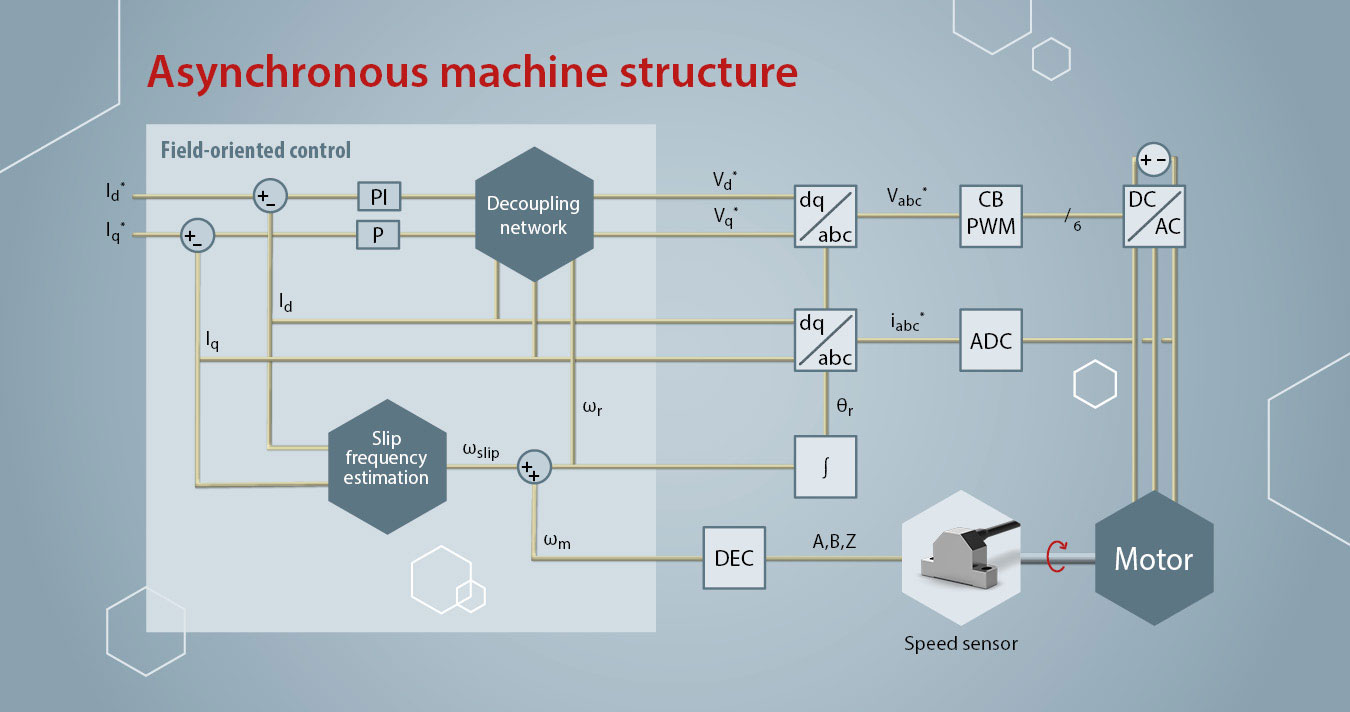
Speed serves as the central control variable in asynchronous motors to ensure stable and dynamic drive behavior. Since the motor inherently operates with slip between rotor and stator due to its physical principle, a slip model is frequently employed to precisely determine the actual rotor position and speed.
Through closed-loop control with sensor feedback, these values can be continuously monitored and adaptively corrected. This enables accurate torque generation, improves starting behavior, and increases robustness under load changes.
Precise speed and position feedback also enhances efficiency, as the motor operates closer to its optimal working point, and improves performance with regard to dynamics, energy consumption, and thermal load.
Compact speed sensors for high-performance electric drives
Speed sensing plays a key role in electric drives, as it forms the basis for precise motor control. Modern sensors capture speed and rotor position with high resolution, enabling the motor controller to align the magnetic flux accurately and achieve maximum efficiency.
Especially during strong acceleration and at high rotational speeds, sensor signals must be stable, fast, and interference-resistant. At the same time, compact motor architectures demand space-saving, thermally robust integration of the sensing components directly within the drive.
Our sensors enable reliable, long-lasting, and performance-optimized control even under demanding operating conditions.
Condition monitoring for modern electric drives
Condition monitoring is the key for the reliability of modern electric drives. Through the continuous acquisition of relevant status data such as temperature, vibrations, and speed, deviations can be detected at an early stage and downtime avoided.
Data-based evaluation methods enable component loads to be monitored in real time and trends to be analyzed. This not only extends the service life of critical components but also optimizes the efficiency of the entire drive system.
Our condition monitoring solutions can be integrated directly into the motor and communicate via standardized interfaces. They enable predictable maintenance, reduced operating costs, and maximum availability of high-performance electric drives.
Sensor solutions for asynchronous motors
GEL 2460
1-/2-channel Hall effect rotational speed sensor with screw-in thread
GEL SEI10
Compact 2-channel Hall effect high-speed rotational speed sensor
GEL 247
1-/2-channel Hall effect speed sensor with voltage or current output and standstill voltage
GEL 2471
1-/2-channel inductive speed sensor for electrically conductive target wheels
GEL 2473
1-/2-channel Hall effect speed sensor for scanning sprockets
GEL 2475
1-/2-channel Hall effect speed sensor with voltage or current output and standstill voltage
GEL 2475CM
Highly integrated speed sensor, vibration sensor, temperature sensor
GEL 2475MS
3-/4-channel Hall effect speed sensor with various signal combinations
GEL 2476
1-/2-channel Hall effect rotational speed sensor with voltage or current output and standstill voltage
GEL 2477
1-/2-channel speed sensor with pulse multiplication
GEL 2478
1-/2-channel Hall effect rotational speed and position sensor with ATEX certification
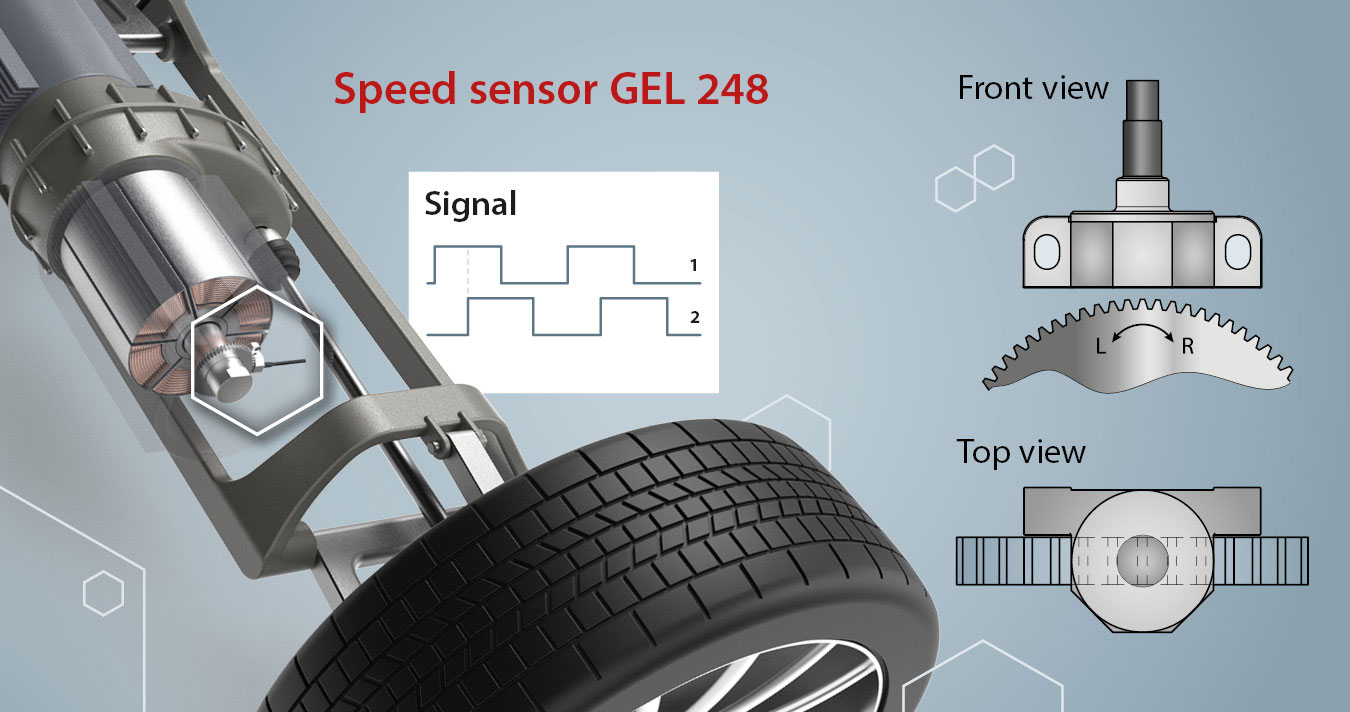
GEL 248
Compact 2-channel Hall effect speed sensorwit HTL- or TTL-output signals
Good to know – quick answers
Which sensors does an asynchronous motor need?
Which sensors an asynchronous motor needs depends on its operating mode and the control requirements. Simple drives can run without an encoder. Field-oriented control, among other things, measures the motor currents and calculates the position of the rotor flux. Speed can be estimated using a model or measured directly with an encoder. Direct speed feedback is especially advantageous at low speeds and with high dynamic requirements. Temperature sensors can add thermal monitoring of windings and bearings. Additional safety requirements depend on the application.
How is speed measured in an asynchronous motor?
The speed of an asynchronous motor can be detected with an incremental encoder. The sensor scans a measuring scale connected to the shaft without contact. The evaluation determines the speed, for example, from the frequency or the time interval of the signals. With absolute encoders, speed can be calculated from the change in position values. Bearingless systems need no encoder bearings of their own and allow compact integration. Alternatively, sensorless control methods estimate the speed from electrical measured variables and a motor model.
When does a bearingless encoder make sense?
A bearingless encoder makes particular sense when installation space is limited, high speeds occur, or additional encoder bearings are to be avoided. The rotating measuring scale is mounted on the motor shaft. The stationary sensor unit scans it without contact. This eliminates the wear of a separate encoder bearing. Bearingless encoders can work inductively, magnetically, or optically, for example. When selecting one, speed, temperature, installation tolerances, environmental conditions, and the required interface must be considered together.