Why robust measurement technology is critical for valid e-motor test bench results
The development of electric motors demands high-precision measurement and sensor technologies in the test bench environment. Sensor solutions are primarily used that deliver robust and accurate signals even under high thermal and dynamic loads.
Whether at high rotational speeds, rapid load changes, or demanding test cycles: the sensing system must consistently provide clear, stable, and highly dynamic signals. Maximum accuracy is required for valid test bench results. This enables precisely calibrated motors, more efficient control strategies, and a development process that reaches its goals faster and more reliably.
Our sensor solutions create an innovative test environment that enables vehicle manufacturers to achieve maximum development quality, greater efficiency potential, and shorter time-to-market cycles.
Precise sensors for large shaft diameters
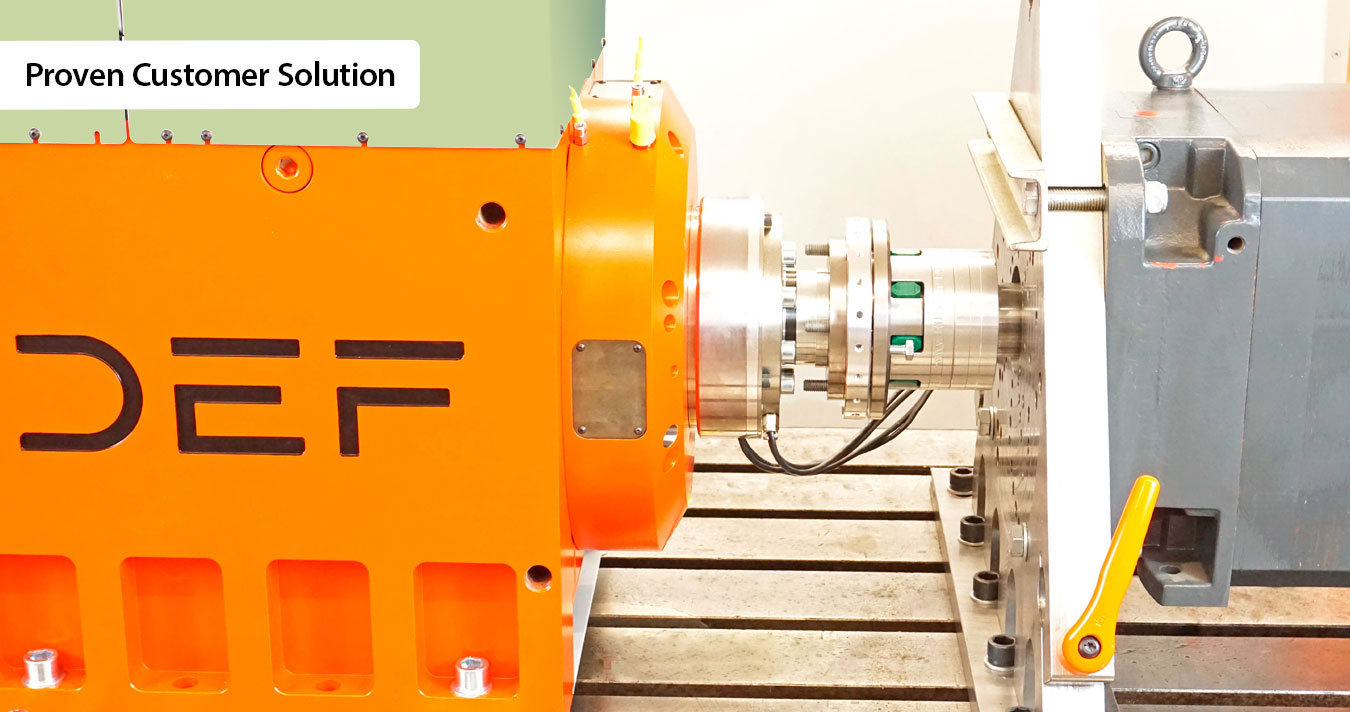
Dynamic E-Flow (DEF) manufactures electric motors for the highest performance requirements and needed a sensor for highly accurate measurement of absolute rotor position and speed – within very limited installation space. "The rotor speed must be detected without bearings, as we use a continuous shaft. In addition, the sensor must be immune to stray magnetic fields, as it is mounted directly on the stator," explains DEF.
Especially for large shaft diameters, suitable solutions for rotor and speed detection are difficult to find. "Lenord+Bauer delivered an extremely robust system, enabling our customers to operate the test bench motors reliably up to the maximum speed and temperature range."
Image source: Dynamic E-Flow, Test bench
Condition monitoring in electric motor test benches
Condition monitoring systems can continuously capture speed, temperature, and vibration data. During an endurance test, the system detects a slight increase in vibration amplitude at the motor shaft – a typical early indicator of incipient bearing fatigue.
The controller then issues a maintenance alert, allowing the affected bearing to be replaced at an early stage before consequential damage occurs. This keeps the test bench highly available for further development and validation cycles.
Sensors for high-speed measurement in test benches
GEL SEK11
Compact inductive rotor position encoder
GEL SEI10
Compact 2-channel Hall effect high-speed rotational speed sensor
GEL 2460
1-/2-channel Hall effect rotational speed sensor with screw-in thread
GEL 248
Compact 2-channel Hall effect speed sensorwit HTL- or TTL-output signals
Good to know – quick answers
Which sensors are used in e-motor test benches?
In test benches for electric motors, torque, speed, rotor position, current, voltage, and temperature are measured, depending on the test task. Torque and speed sensors make it possible to determine the mechanical power. Suitable power analyzers record the electrical power. Rotor position sensors support motor control and the synchronization of measurement data. Temperature measurements serve the thermal evaluation of the drive. For efficiency tests, suitable, calibrated measurement chains and an assessment of their measurement uncertainty are decisive. For inverter-fed AC motors, IEC 60034-2-3 in particular describes corresponding test methods. The specific sensor selection depends on the test objective, speed range, and required dynamics.
What are typical speeds in electric vehicle drives?
The maximum speeds of electric vehicle drives differ significantly by vehicle class, motor design, and gear ratio. Many traction drives operate at maximum speeds in the five-digit rpm range. High-speed concepts can go beyond that. However, the highest speed is not the only factor in selecting a sensor. Signal quality at low speeds, direction detection, and, where applicable, rotor position detection at standstill must also suit the application. At high speeds, signal delay, evaluation bandwidth, and the mechanical design of the rotating measuring scale require particular attention. The specified operating limits of the entire sensor system are decisive.
What accuracy is required for test bench measurements?
The required accuracy depends on the test task. For efficiency measurements, the uncertainties of the electrical and mechanical power measurement must be evaluated together. This includes in particular current, voltage, torque, and speed, as well as their time-synchronized acquisition. For investigations of torsional vibrations or noise and vibration behavior, bandwidth and time or angular resolution are also important. High resolution alone does not guarantee high measurement accuracy. Blanket minimum values for angular resolution or pulse count are therefore not meaningful. The test method, the operating point, and the measurement uncertainty of the entire measurement chain are decisive.