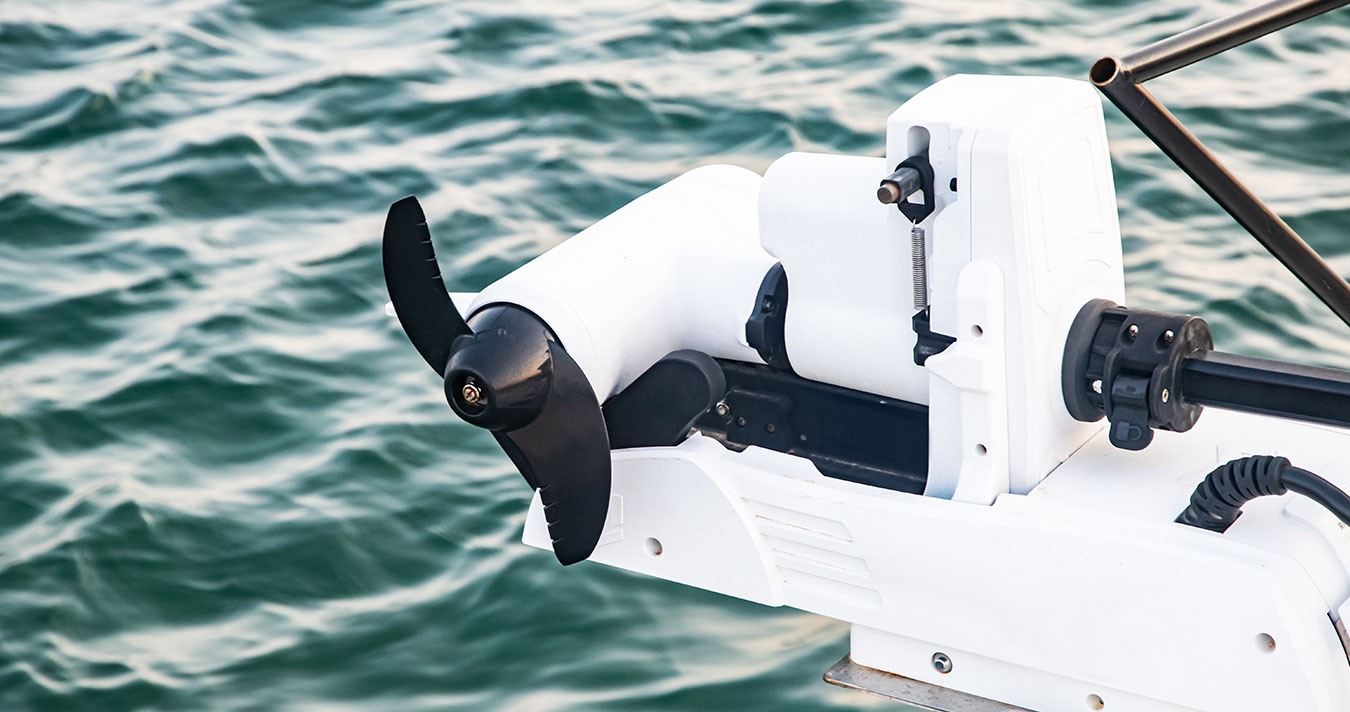
Also in the maritime industry electric drives are becoming increasingly important – they are emission-free, quiet and low-maintenance. For maximum performance, reliability and energy efficiency, precise control with high-resolution sensors is critical.
As power density increases, electric drive motors are becoming ever more compact. Our modern sensor technology adapts flexibly to these requirements. In addition to our proven standard products, we develop customer-specific designs that can be seamlessly integrated into any motor design – saving you the need to adapt the motor to the sensor.
Compact sensors for confined installation spaces in bow thrusters
In bow thrusters, precise speed acquisition and exact positioning provide reliable actual values for drive control. They thus form an important basis for higher-level control and maneuvering systems.
Thanks to their extremely compact design, the bearingless rotary encoders GEL 2475 are a space-saving solution for use in confined installation spaces.
Efficient signal processing in azimuth thrusters
Our bearingless rotary encoders GEL 2477 are successfully deployed in pod drives and offer high precision as well as maximum reliability. An important advantage here is pulse multiplication, which significantly increases resolution and thus optimizes control.
Thanks to their robust design and modern sensor technology, the bearingless rotary encoders operate with lasting stability and minimal maintenance even under severe temperature fluctuations, such as those caused by the motor located in the pod.
Pole position acquisition in outboard motors
Tightened emission limits and restrictions on diesel drives are accelerating the transition to efficient electric motors in the motorboat and sailing boat sector. The ideal solution for acquiring rotor position is the highly integrated, robust and precise VarioCODER.
It can be flexibly adapted to the intended installation location in the motor, tolerates significantly larger mounting deviations than conventional resolver systems and operates reliably even under axial shaft displacement. The rotary position sensor thus offers maximum accuracy and robustness for compact electric drive systems.
Sensor solutions for electric motors
GEL 2475
1-/2-channel Hall effect speed sensor with voltage or current output and standstill voltage
GEL 2477
1-/2-channel speed sensor with pulse multiplication
GEL SEK11
Inductive rotor position encoder, compact
GEL SEK20
Inductive rotor position encoder, robust
Good to know – quick answers
How is rotor position detected in electric ship propulsion systems?
Rotor position is detected with encoders or resolvers at the shaft end of the motor. In pod drives and bow thrusters, the encoder is usually mounted directly on the rotor or the propeller shaft. With permanent magnet synchronous motors, the measured value must be correlated with the electrical rotor position. The signals provide speed and angular position for the field-oriented control of the drive, so that torque and speed can be controlled precisely. Absolute measuring systems provide the rotor position immediately at power-up, without a homing run. Redundant designs increase availability and support the requirements of safety-related drives.
How does higher encoder resolution improve the control performance of pod drives?
Higher encoder resolution can improve speed estimation at low speeds. The effect on control performance also depends on angular accuracy, signal delay, and controller tuning. At the same time, losses decrease because the drive runs closer to its optimum operating point. This requires low signal delay and high noise immunity of the interface. The pod’s azimuth position is measured separately, using its swivel angle.
What advantages do inductive encoders offer over optical encoders in maritime applications?
Inductive encoders detect position through electromagnetic coupling and do not require an optical scanning path, which makes them insensitive to humidity, salt spray, oil, and dirt. Optical systems, in contrast, can be impaired by condensation or contamination of the code disc. Inductive encoders also withstand shock, vibration, and wide temperature ranges, do without fragile glass discs, and are designed for a long service life. This reduces the risk of failure and maintenance effort and increases drive availability over the entire life cycle.